Employment Standards
Expert guidance on employer/employee rights, human rights issues, and employment matters including hiring and termination.
Benefits of Our Employment Law Service
- Protection of your workplace rights
- Resolution of disputes with employers or employees
- Assistance with wrongful dismissal claims
- Guidance on human rights in the workplace
Why Choose Us
Our employment law team helps both employers and employees navigate workplace legal issues, from contract negotiations to termination disputes and human rights matters.
Contact Us
Employment Rights in Ontario
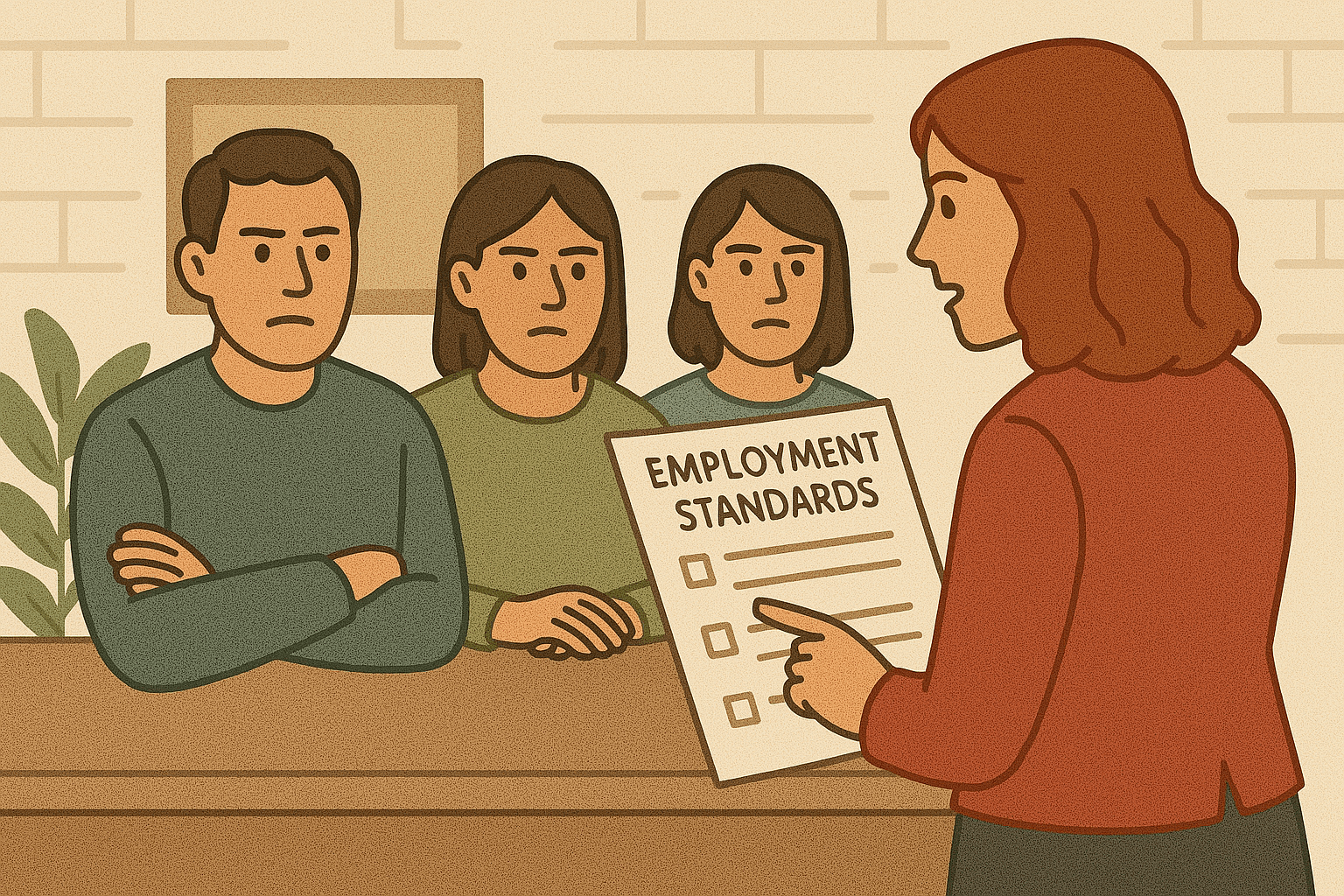
Ontario's Employment Standards Act, 2000 (ESA) sets the minimum rules for most provincially regulated workplaces: minimum wage, hours of work, overtime, vacation, public holidays, leaves of absence, and termination and severance pay. We help employees understand and enforce these rights, and help small employers comply with them.
Common matters we handle include unpaid wages and overtime, termination without proper notice or pay, severance entitlements, temporary layoffs, and disputes over employment contracts. Where a dismissal claim is worth up to $50,000, our licensed paralegals can pursue it in Small Claims Court; we also assist with Ministry of Labour ESA claims.
Many GTA workers — particularly newcomers working in their second language — are never told their minimum entitlements. We advise clients in English, Cantonese, Mandarin, and Korean so nothing is lost in translation.
CourthousesKey Ontario Employment Standards
Termination: after three months of employment, the ESA requires written notice of termination or pay in lieu — generally one week per year of service up to a maximum of eight weeks. Severance pay is a separate, additional entitlement for employees with five or more years of service where the employer's global payroll is at least $2.5 million.
Many employees are owed more than the ESA minimums. Unless a valid employment contract limits entitlements, common-law "reasonable notice" can be substantially longer than the ESA schedule — and Ontario courts have voided many termination clauses for falling short of the ESA. A termination offer should be reviewed before you sign anything.
Overtime: most Ontario employees must be paid time-and-a-half after 44 hours in a work week. Job titles alone (such as "manager") do not eliminate overtime rights — what matters is the work actually performed.
Deadlines matter. Ministry of Labour ESA claims are subject to a two-year limit on recovering wages, and court claims are generally subject to Ontario's two-year limitation period. Note that you generally cannot pursue the same wages through both an ESA claim and a court action — choosing the right forum is a strategic decision.
Our Process
Initial Consultation
We begin by understanding your employment situation and identifying relevant legal issues and potential remedies.
Case Assessment
We analyze employment contracts, workplace policies, and relevant laws to develop a strategic approach to your case.
Resolution
We work toward resolution through negotiation, mediation, or formal legal proceedings as appropriate for your situation.
Frequently Asked Questions
How much termination pay am I entitled to?
The ESA minimum is roughly one week of notice or pay per year of service, to a maximum of eight weeks, after three months of employment. Your true entitlement may be much higher under the common law if your contract does not validly limit it. Have any severance offer reviewed before signing a release.
Can my employer fire me without cause?
In Ontario, most employers can end employment without cause — but they must provide proper notice or pay in lieu, and the dismissal cannot be for a discriminatory reason or a reprisal for exercising your rights. "With cause" terminations that deny notice are held to a high legal standard.
What is the difference between an ESA claim and suing in court?
A Ministry of Labour claim is free and enforces ESA minimums only. A court action (such as Small Claims Court for claims up to $50,000) can capture common-law notice, which is often larger. You generally cannot do both for the same wages, so it is important to choose the right route first.
Am I owed overtime even though I am salaried?
Possibly. Salaried status does not remove overtime rights. Unless your role falls within a true exemption (for example, genuine managerial duties), hours over 44 in a week must be paid at 1.5 times your regular rate.
How long do I have to bring a claim?
Generally two years. Court claims are subject to Ontario's two-year limitation period, and Ministry of Labour ESA claims have a two-year recovery window. Earlier is always better — evidence and witnesses fade.
Ready to Get Started?
Contact us today to schedule a confidential consultation with our experienced legal team. We're here to help you navigate your legal challenges.